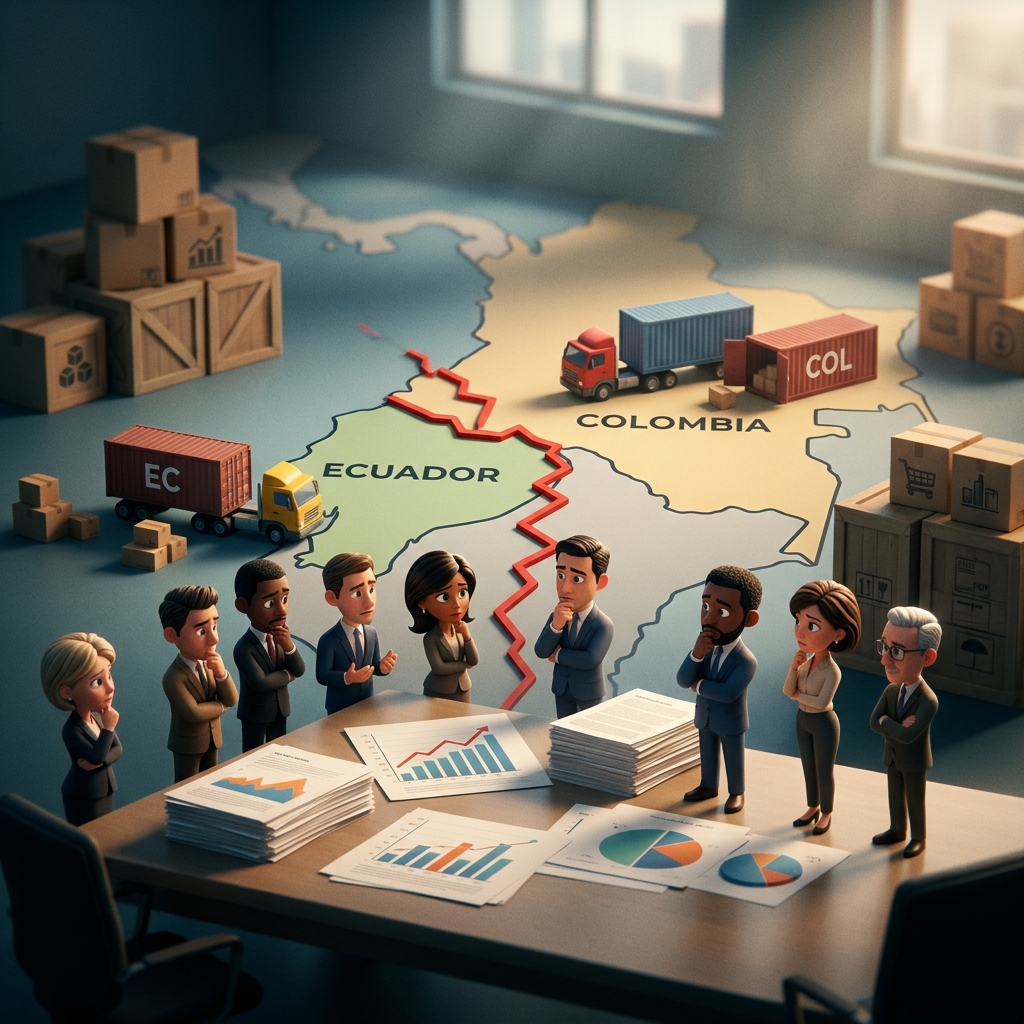
The relationship between Ecuador and Colombia suffered an unprecedented crisis in 2026.
A 30% security tariff, its increase to 50%, the threat of escalation to 100%, and Colombian retaliatory measures transformed prices, contracts, and sourcing decisions within just a few weeks. Ecuador's imports from Colombia fell 58% year-over-year in March, while exporting companies, freight operators, and border businesses faced cancellations, reduced activity, and uncertainty that was difficult to pass on to clients.
This premium report reconstructs the complete sequence of events, separates announcements from measures actually implemented, and avoids a misleading conclusion: the crisis did not end in a permanent rupture. The Andean Community ordered the removal of restrictions, and trade partially recovered from June onward. However, customs normalization did not immediately restore trust, recover lost contracts, or reduce the perception of risk.
The report quantifies bilateral exposure using 2025 and 2026 data, analyzes the impact channels on costs, working capital, inventories, production, sales, and employment, and explains why the pharmaceutical, chemical, food, packaging, plastics, construction, and auto parts sectors face different levels of risk. It also examines the interaction between trade, electricity, oil, and border security.
The most practical section compares supply alternatives. Peru emerges as the most immediate secondary regional source; Brazil offers industrial depth; Mexico and the United States broaden the supply of regulated and technological goods; China can reduce unit prices with longer lead times and tied-up capital; and domestic production is strategic only where capacity, quality, and scale exist. The analysis demonstrates that no single origin fully replaces Colombia without additional costs.
The report concludes with a concrete business strategy: maintain efficient Colombian suppliers, qualify a second source for critical inputs, use safety inventories selectively, incorporate regulatory change clauses, and monitor concentration by country and product. It is a tool for deciding what to diversify, how much inventory to hold, where to find new suppliers, and how to rebuild sales in Colombia without repeating the dependency the crisis exposed.
Compra este informe o hazte miembro.
Compra este informe o hazte miembro.
Más detalles, da click en la imagen.