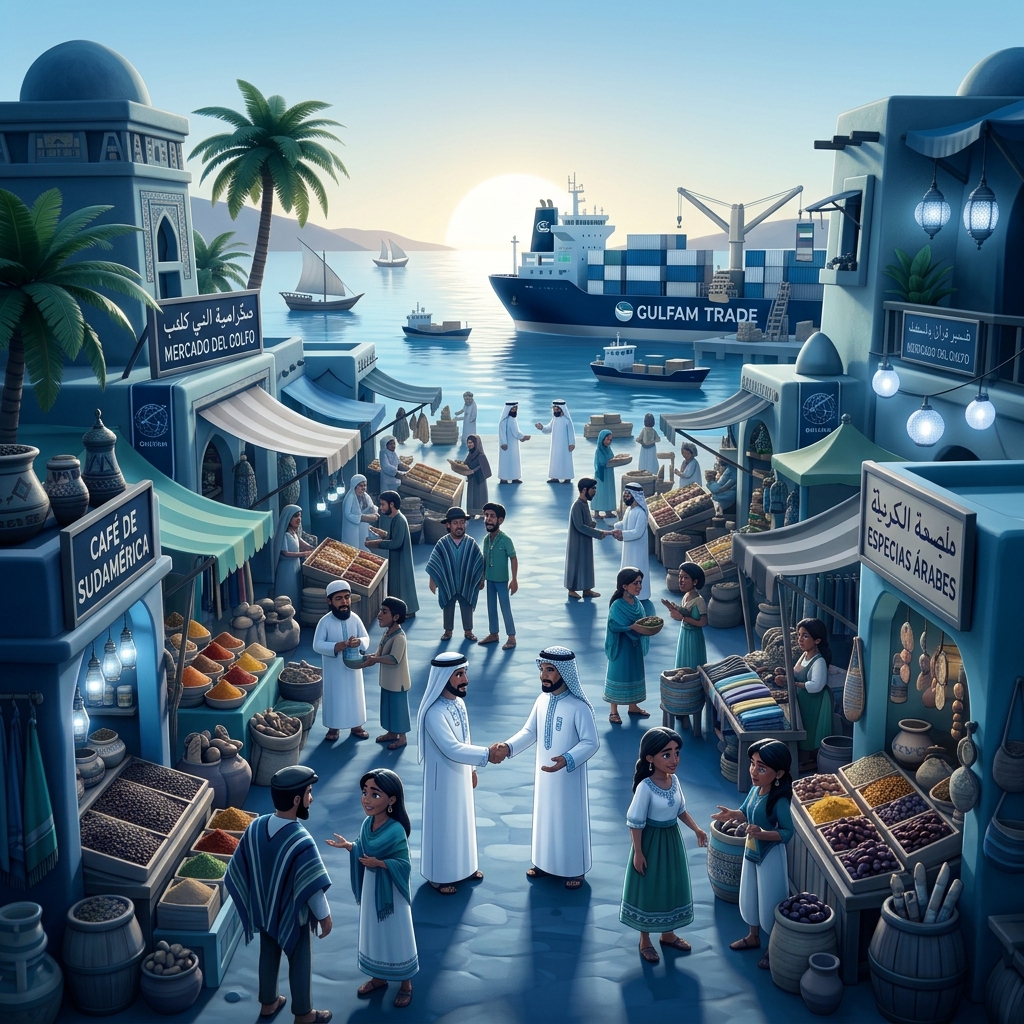
Gulf countries imported USD 739.9 billion in goods in 2024 and sent USD 130 billion in direct investment abroad in 2025.
For South America, this combination creates a double opportunity: selling to high-income consumers and businesses, and attracting capital for infrastructure, energy, mining, technology and logistics. However, the potential is not distributed automatically. Brazil already operates at scale, Chile has an agreement in force with the United Arab Emirates, and Ecuador and Colombia are advancing through institutional routes that still need to translate into effective implementation. Meanwhile, Mercosur is negotiating its own access.
Gulf Markets 2026 turns this scenario into a decision-making tool. The report compares the six markets of the Gulf Cooperation Council and explains where each one fits: the Emirates as a regional hub, Saudi Arabia as a scale market, Qatar and Kuwait as high-income niches, Oman as an industrial and logistics platform, and Bahrain as a services center and pilot market. Readers will find data on GDP, trade, investment, food dependency and agreements, as well as an assessment of the sectors with the greatest potential for South American supply.
The analysis delves into animal protein, aquaculture, fruits, coffee, cocoa, grains, critical minerals, renewable energy, infrastructure and digital services. It does not limit itself to listing opportunities: it identifies the conditions that determine success, from halal certification, health registration and shelf life to landed price, distribution channel, traceability, governance and bankability. A regional matrix shows the strengths and gaps of the main South American countries, and a Gulf comparison allows prioritizing the entry route according to product, scale and risk profile.
The 2026 edition also incorporates the situational change caused by tensions in the Strait of Hormuz and the Red Sea. It explains how the disruption affects freight, insurance, inventories, investment and growth, and proposes contractual and logistical responses. The document concludes with a 90-day business plan, a 12 to 24-month public agenda, and go/no-go rules to avoid depending on preferences not yet in force or on projects without cash flow. It is a reference for exporters, investors, chambers of commerce, consultancies, banks, promotion agencies and strategy leaders who need to turn interest into verifiable business.
Compra este informe o hazte miembro.
Compra este informe o hazte miembro.
Más detalles, da click en la imagen.